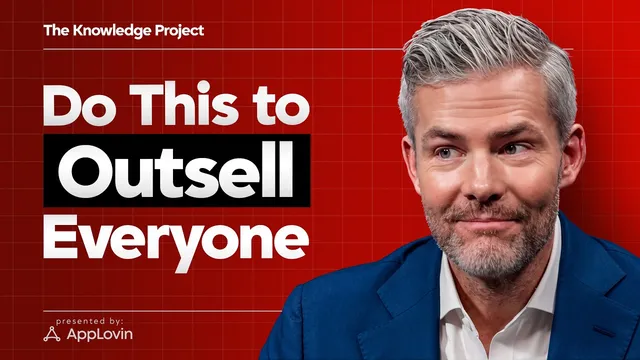
Full episode · 1 h 5 m
Tobi Lütke: The Skills AI Makes More Valuable
Shopify CEO Tobi Lütke says AI makes taste, judgment and taking responsibility more valuable, and that lasting companies must prune and rebuild.
 The Knowledge Project · Shane Parrish with Tobi Lütke
The best minutes
- 36:35Intuition matters most when the best path has no feedback2 min
- 40:39The hard part is choosing among many good options2 min
- 14:02Machines can't take responsibility, so use an AI council2 min
Also worth watching
- 7:12Shopify's River agent now drafts about half its pull requests4 min
- 50:46Why Shopify treats churn as a good sign, not a failure2 min
- 56:56Why teams should prune and refound products instead of adding5 min
Skip the opening riff on computing history, the superintelligence-as-society discussion, and the closing book recommendations.
Summary · 5 min read instead of 1 h 5 m
Tobi Lütke is the founder and CEO of Shopify. The episode covers how Shopify uses AI agents, including an internal AI colleague called River. He also describes how he makes decisions and tries to improve himself.
Lütke says very few people at Shopify write code without agents, and that River, an AI with a personality and memory, now sits at the center of the company's work. He argues that machines cannot take responsibility, so humans must keep making the judgment calls, and he uses AI to build better inputs for those calls. He says taste, systems understanding and intuition grow in value, and that the hardest decisions are choices among several good options, often without quick feedback. He closes on affirmations, pruning and refounding events, and old books.
Minute by minute
- 0:14
Engineering at Shopify now runs on agents. Lütke says very few people at Shopify write code directly, and those who do work with many agents at once, often 10 to 50 instances. He says the computing industry does not know its heroes and keeps rediscovering old lessons, such as the file system. He argues agents bring back the old habit of analogizing the digital world to the physical one.
- 5:05
River was given a personality and memory. Lütke praises Microsoft's Sydney chatbot, which had a real personality, and says the industry's fear after its scandal led to bland, patronizing AIs. He bet the opposite way at Shopify. River, in Slack, has a name, a profile picture, memory by channel and permission to be sarcastic or call a request stupid. He says up to about 50 percent of pull requests now come out of company chat conversations.
- 8:51
Open channels spread AI skills by osmosis. Lütke made River work only in open channels so people can watch each other use AI. He wanted to reproduce the osmosis learning of offices, where junior and senior engineers sat together. He calls the result phenomenally successful, since colleagues ask River to summarize, diagram, research or prototype in front of everyone. He also describes a nightly process in which River reviews its day and updates its skill files.
- 11:48
An AI council informs hard decisions. Lütke uses an AI chief of staff that spawns sub-agents with different roles, such as data, research, business and engineering. They run across several models, and a randomly chosen model synthesizes the results. He says it costs 15 to 20 dollars in tokens and returns in half an hour what could take a month. He says AI is not as good at judgment as he is and that he uses it to create the right environment for judgment.
- 16:00
Slop grenades are AI's new failure mode. Lütke says lazy work with AI now shows up as too much output rather than too little. Shopify calls these "slop grenades": unread AI pull requests and long emails that the recipient compresses with another model. He also says AI phrases such as "load-bearing" are creeping into how people talk, and he notices it in his own language.
- 19:42
Software will mold itself to its user. Lütke says his method for predicting the future is to live in others' relative future and copy solutions from adjacent fields. He describes his Omaki Linux setup, where he asks an agent to change anything and built a screenshot annotation tool in minutes. He says other people sent six pull requests after he open sourced it. He believes Shopify is heading toward software that molds itself around how a business runs.
- 24:31
Humans must own the decisions. Lütke says he does not try to replace himself because his job is judgment and taking responsibility. He says he would let AI run Shopify if it were better, but machines cannot go to jail or face recourse. On superintelligence, he argues that cities and societies already act as one, held in check by systems like police. He expects synthetic superintelligence to arrive as an ordinary day.
- 31:07
Taste and systems study grow in value. Lütke says taste and judgment become more valuable, and that teenagers should cultivate taste through deep study and many reps. He recommends studying why systems last, such as the Catholic Church's four layers of management. He argues people prefer complex answers because simple ones make poor stories, but the true answers are usually simpler. He defines judgment as finding the best trade-offs and intuition as judgment at an instant.
- 36:33
The best path often lacks feedback. Shane raises Kahneman's criteria for intuition, including rapid feedback. Lütke disagrees and says intuition matters most when no feedback exists. He argues executives follow local incentives like quarterly results, and that the right long-term path often has no feedback loop. He says the hard part is choosing among several good options, not finding one right one, and he distrusts orthodox solutions except in regulated fields like payments.
- 44:49
Affirmations can rewire behavior. Lütke treats himself as a project of recursive self-improvement and says affirmations are the easiest way to build mental habits. He wrote that he loves public speaking for about a week, five minutes a day, and says he now gets energy from speaking. He says people should not tell themselves they are bad at math. His kids must add "yet" to any statement that they can't do something.
- 50:47
Metrics become goals and mislead companies. Lütke says Goodhart's law reigns in companies, and a metric turned into the goal gets overfit. His example is churn at Shopify: investor-written papers called it the key metric, but a failed store is an experiment, and he expects those entrepreneurs to come back. He adds that love and hate are both valid targets for creators and indifference is the real failure.
- 52:31
Beauty is how intuition communicates. Lütke says caring about the unseen parts of a product, such as architecture, prose and legibility, is the craftsperson's job. Shopify built much of its code in Ruby and talked often about beautiful code. He suggests intuition communicates through aesthetics, citing chess and Go players who say they looked at one line because it seemed beautiful. He says this lets people use the brain's parallel part.
- 56:17
Progress comes from pruning and rebuilding. Lütke uses SpaceX's Raptor engines as an example of improving by subtraction. He says each version could have stopped, and that the third version removed pipes that earlier versions needed. He says failure is only a problem when catastrophic, and that failure frees scarce people for other work. He proposes refounding events for departments, a 2.0 start from the top, and says old tech companies piled layers on layers.
- 1:02:12
Old books still work as cheat codes. Lütke says his view on books has not changed, though he now reads little recent non-fiction because it reflects its time. He names Parkinson's law, The Lessons of History, James Burnham's The Managerial Revolution and The Machiavellians, Meditations, and the Foundation series. He defines success as cultivating skills and creating things that improve other people's days.
Published Sep 15, 2026.