Full episode · 1 h 44 m
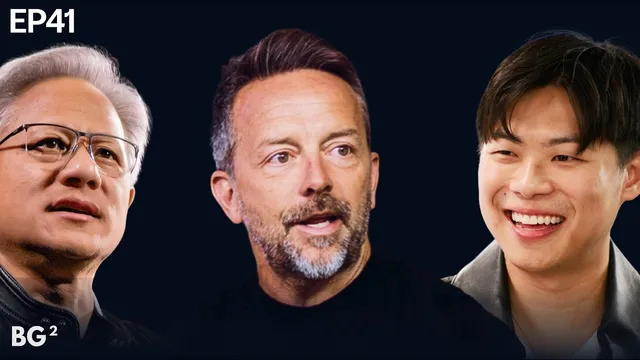
NVIDIA: OpenAI, Future of Compute, and the American Dream | BG2 w/ Bill Gurley and Brad Gerstner
Jensen Huang says OpenAI will likely become a multi-trillion dollar hyperscaler and that AI infrastructure demand far exceeds Wall Street's forecasts.
 BG2 · Brad Gerstner & Clark Tang with Jensen Huang
The best minutes
- 50:22Why even free ASICs lose to NVIDIA when power is the limit4 min
- 11:26The math behind a $5 trillion annual AI infrastructure market5 min
Also worth watching
- 3:33How NVIDIA's OpenAI deal differs from its existing builds5 min
- 31:49Why NVIDIA must ship annually when Moore's law has stalled4 min
- 41:23Why ASICs stop making sense once a market gets large6 min
Skip the roughly 45-minute closing run on sovereign AI, Washington policy, China, H-1B, Invest America and future talk.
Summary · 5 min read instead of 1 h 44 m
Huang founded NVIDIA and runs it as CEO; Gerstner describes it as a $4.5 trillion company. Huang says NVIDIA invented CUDA and GPUs and now sells AI infrastructure rather than only chips. He also says his parents sent him to the US with no money and that he bussed tables, washed dishes and cleaned toilets.
Huang says three scaling laws (pre-training, post-training and thinking) are pushing compute demand up exponentially, and that NVIDIA's investment of up to $100 billion in OpenAI is a bet on the next multi-trillion dollar hyperscaler. He argues Wall Street's growth forecasts miss the shift from general-purpose to accelerated computing and the augmentation of human intelligence, which he sizes at about $5 trillion of annual capex. He says extreme co-design, an annual release cadence and supply chain scale widen NVIDIA's lead over ASICs. He backs sovereign AI, selling into China and a pro-immigration American dream, and says AI will change jobs rather than destroy them.
Minute by minute
- 1:36
Three scaling laws drive inference demand. Huang says AI now has three scaling laws: pre-training, post-training (AI practicing a skill through reinforcement learning) and inference as thinking before answering. He says he underestimated this and is more confident than a year ago that inference will grow by a billion times. His reason is that AI is now a system of language models running concurrently with tools and research.
- 3:22
Nvidia invests in OpenAI's self-built factories. Gerstner cites the $100 billion investment and 10 gigawatts that could mean upwards of $400 billion in NVIDIA revenue. Huang says OpenAI will likely be the next multi-trillion dollar hyperscale company, so investing early is a smart bet. He says the deal is additive to the Azure, OCI and CoreWeave build-outs and helps OpenAI build its own infrastructure with a direct relationship to NVIDIA, as Meta and Google have.
- 8:38
Why Huang sees a larger market than analysts. Gerstner says sell-side consensus has NVIDIA growing 8% a year from 2027 through 2030, and Huang says he is comfortable with that. Huang gives three arguments: general-purpose computing is moving to accelerated computing, hyperscale CPUs are moving to AI, and AI will augment human intelligence that he puts at about $50 trillion of GDP. He estimates $5 trillion of annual capex against about $400 billion today, a 4 to 5x increase.
- 18:52
Shortage of compute, not a glut. Huang says NVIDIA sits at the end of the supply chain, has geared it up to double if needed, and is waiting on demand signals. He says customer forecasts have kept coming in too low, leaving NVIDIA in scramble mode. On round-tripping, he says the $400 billion for 10 gigawatts must be funded by OpenAI's revenue, equity and debt, and that NVIDIA's investment is not tied to chip purchases.
- 31:04
Annual cadence needs extreme co-design. Huang says token generation and users are both growing exponentially while Moore's Law is dead, so performance must rise every year to hold down token cost. He says Kepler to Hopper was about 100,000x in 10 years, and Hopper to Blackwell was 30x in one year using NVLink 72. He attributes this to co-designing the model, algorithm, system, chips, networking and software together.
- 37:35
Scale widens Nvidia's competitive moat. Huang says there is more competition than ever but it is harder to win, because wafer costs are rising and a gigawatt means 400,000 to 500,000 GPUs working together. He says customers will place $50 billion purchase orders only on a proven architecture, and suppliers will start hundreds of billions of dollars of wafers and DRAM only for a company that can deliver. Gerstner concludes the moat is growing.
- 40:39
ASICs struggle against full AI factories. Huang says Google's TPU succeeded through foresight in starting before the market grew, and that new ASIC entrants now face an AI factory rather than a single chip. He cites CPX, the open-sourced Dynamo and NVLink Fusion with Intel as NVIDIA's response. He expects ASICs to stay useful for narrow jobs like video transcoders and smart NICs, and says large ASIC businesses move to customer-owned tooling.
- 50:21
Even free ASICs lose on tokens per watt. Huang says customers are power limited, so twice the tokens per watt means twice the revenue from the same two gigawatts. He says the gap between NVIDIA's gross margin of about 75 points and rivals' 50 to 65 points cannot make up for Blackwell's 30x advantage over Hopper. He concludes that the opportunity cost makes the best performance per watt the right choice even against a free chip.
- 55:16
Huang expects a $10 trillion NVIDIA. Huang says NVIDIA's opportunity is much larger than consensus and that it will likely be the first $10 trillion company. He says NVIDIA is an AI infrastructure company that sells chips, components, networking or full racks as customers prefer. He also praises Elon Musk as a builder who holds the whole system, including financing, in his head, and would not be surprised if he reaches a gigawatt first.
- 58:40
Every country needs sovereign AI infrastructure. Huang says everyone needs AI because computing has been reinvented, so countries should use models like OpenAI's and Gemini but also build their own AI infrastructure. He praises David Sachs and Sriram Krishnan, and says President Trump is pro-growth and pro-energy and wants the world built on American technology. He backs maximizing American exports and influence.
- 1:07:39
Huang says China is nanoseconds behind. Huang says China is competitive, hungry, lightly regulated and manufactures well, and that claims it could not build AI chips were wrong. He argues NVIDIA competing in China serves both countries and keeps American technology as the world's base. He says NVIDIA's guidance includes no China, but the market remains very important and he is confident wisdom will prevail.
- 1:17:19
H-1B fee is a start, talent pipeline at risk. Huang calls the $100,000 H-1B fee a great start that probably sets the bar a little too high, and says it at least curbs abuse. Gerstner notes it favors big companies, and Huang agrees it may push investment abroad. He says fewer Chinese students wanting to stay is an early indicator of a future problem, and that damaging the pipeline of the American dream is not patriotic.
- 1:29:31
Invest America gives every child a stake. Gerstner says the Invest America provision, passed in the Big Beautiful Bill, will from 2026 seed every newborn's investment account with $1,000 in American companies. Gerstner says NVIDIA will add to accounts for employees' children. Huang thanks him for driving it and ties it to keeping people from feeling left behind as AI creates abundance.
- 1:32:26
AI changes jobs but creates more work. Huang says re-industrializing America, aspirational projects and AI as an equalizer will bring people along. He says AI will eliminate some tasks and create others, and NVIDIA is hiring more engineers because it has more ideas to pursue. He expects AI fused with robotics within five years, advises CEOs to get on the exponential train early, and says intelligence is not a zero-sum game.
Published Sep 26, 2025.