Full episode · 1 h 14 m
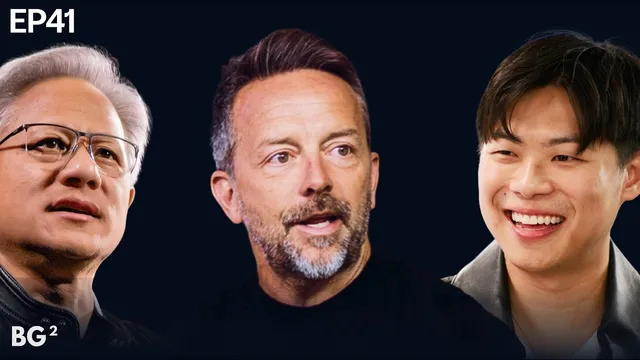
All things AI w @altcap @sama & @satyanadella. A Halloween Special. 🎃🔥BG2 w/ Brad Gerstner
Nadella and Altman tell Brad Gerstner the Microsoft–OpenAI deal fits both sides, compute is the bottleneck, and a glut will come at some point.
 BG2 · Brad Gerstner with Satya Nadella and Sam Altman
The best minutes
- 15:12Compute demand depends on price, and a glut will come6 min
- 42:32Why Microsoft built a fungible fleet and said no to OpenAI4 min
- 53:32SaaS will survive AI if it is low ARPU and high usage3 min
Also worth watching
- 32:37How Nadella made the 2019 OpenAI bet and who he trusted5 min
- 37:37Why Microsoft treats royalty-free model IP as the core of the deal2 min
- 1:00:13Chat has worse unit economics than search, and agents become seats4 min
Skip the 10-minute opener on stakes and the nonprofit, the state AI-law talk, and the closing talk on reindustrialization.
Summary · 5 min read instead of 1 h 14 m
Satya Nadella leads Microsoft, which began investing in OpenAI in 2019. Sam Altman leads OpenAI, the maker of ChatGPT. The two joined Brad Gerstner after announcing a revised partnership that came with OpenAI's restructuring.
Nadella and Altman walk through the restructured partnership: Microsoft's roughly 27% stake, a large OpenAI nonprofit, Azure exclusivity for stateless APIs through 2030, and a revenue share that runs to 2032 or until AGI is verified. Altman defends OpenAI's $1.4 trillion compute commitments by pointing to steeply growing revenue. Both say compute and power are scarce now, though a glut will come at some point. Nadella argues Microsoft's fungible fleet, Copilot products and low-ARPU, high-usage software position it well as agents change SaaS. Both back federal AI preemption, and Nadella expects AI to raise productivity and support US reindustrialization.
Minute by minute
- 2:31
Microsoft's stake and the OpenAI nonprofit. Gerstner puts Microsoft's investment at about $13 to $14 billion for a stake of about 27% on a fully diluted basis, and Nadella confirms that. Nadella says Microsoft is proud to be tied to the Gates Foundation and the new OpenAI Foundation. Altman says the structure lets the nonprofit grow in value while the public benefit corporation raises the capital it needs. Altman names health and AI resilience as first focus areas.
- 7:45
Azure exclusivity and the revenue share. Altman says stateless APIs stay exclusive to Azure through 2030, while OpenAI's other products can go to other platforms. Gerstner says the revenue share and exclusivity run until 2032 or until AGI is verified by an expert panel. Gerstner uses 15% only as an illustration, and Nadella says the share runs to AGI or the end of the term. Both call the process for judging AGI sensible.
- 11:34
Defending $1.4 trillion of compute commitments. Gerstner asks how a company with $13 billion in reported revenue can support $1.4 trillion in commitments over four or five years. Altman says OpenAI earns well above that figure and is betting revenue keeps rising, with ChatGPT, an AI cloud, consumer devices and automated science as drivers. He accepts the risk of getting it wrong. Nadella says OpenAI has beaten every business plan he has seen.
- 15:16
Compute shortage now, glut eventually. Altman compares compute to energy: demand depends on price, and a 100-fold drop in cost per unit of intelligence would raise usage by more. Nadella says the biggest constraint is power and builds near it, and he has chips he cannot plug in for lack of warm shells. Altman says a glut will come at some point, and he puts the fall in cost per unit of intelligence at about 40x per year. Nadella adds that software gains are outpacing Moore's law.
- 22:18
No set date for an OpenAI IPO. Altman says OpenAI has no date or decision on going public, though he assumes it will happen someday. Gerstner calculates that 10 times $100 billion in revenue would mean a $1 trillion valuation, and selling 10 to 20 percent would raise $100 to $200 billion. Altman says he would like to go public on the strength of revenue growth. He also likes the idea of retail investors being able to buy shares.
- 24:06
A state AI law patchwork would hurt. Gerstner describes federal preemption being dropped from the budget bill and cites the Colorado AI Act as an example of state rules. Altman says he does not know how OpenAI would comply with it and fears a 50-state patchwork. Nadella says large firms can cope, but startups cannot, and he favors a federal framework that addresses safety. Both doubt the EU and US will align.
- 27:41
Coding agents and a new interface. Altman expects Codex tasks to move from hours to days next year, and he hopes AI makes very small scientific discoveries in 2026. Nadella describes the shift as macro delegation with micro steering, which he says chat interfaces suit poorly. Altman says new devices are needed for that workflow. Gerstner adds a consumer case: a personal assistant for billions of people. Altman leaves the call afterward.
- 32:29
Why Nadella backed OpenAI in 2019. Nadella says Microsoft had been obsessed with natural language since 1995, so Altman's 2019 talk of text, transformers and scaling laws fit. He says Bill Gates was skeptical until he saw the GPT-4 demo. Seeing early code completions in GitHub Copilot gave him the confidence to go from one to ten. He credits Kevin Scott's change from skeptic to believer.
- 36:56
Strategic value beyond the equity stake. Nadella says the key strategic value is Azure's exclusivity on the stateless API, which enterprises combine with compute, storage and databases. He also cites royalty-free access to OpenAI's IP for seven more years, which he compares to having a frontier model for free. He says Microsoft 365 Copilot is bigger than any prior suite. On losses, he says Microsoft cannot lose more than the $13.5 billion it invested.
- 42:02
A fungible fleet and a $400 billion backlog. Nadella says Microsoft chose a fleet that is fungible across workloads, geographies and chip generations. That meant sometimes declining demand, including a dedicated multi-gigawatt training site for OpenAI, so Azure could serve other customers and its own Copilots. Gerstner cites 39% Azure growth, and Nadella agrees it would have been higher with more compute. He says the $400 billion of remaining performance obligations averages a two-year duration.
- 47:33
Nothing is a commodity at scale. Nadella says compute and storage look like commodities, but scale lets Microsoft's costs fall faster, and the OpenAI partnership gave it scale. He says Microsoft treats cloud capital as one outlay across its businesses. On circular deals, he says the $13.5 billion was not booked as Azure revenue, vendor financing is not new, and demand will test circularity.
- 52:29
SaaS splits into token and agent factories. Nadella says the agent tier is replacing the old business logic tier of SaaS. He argues Microsoft 365 is low ARPU and high usage, and AI adds data to its graph, so he sees an accelerant. He splits value between a hyperscaler's token factory and an agent factory, and says software now carries real marginal cost. Chat has worse unit economics than search, and he calls enterprise monetization clearer than consumer.
- 1:03:53
Productivity gains and headcount leverage. Nadella says the productivity curve will bend as people learn to work with agents, much as Excel changed forecasting. He says Microsoft's headcount will grow with more leverage than before AI. His example is a network operations leader who built agents to handle work across about 400 fiber operators. Gerstner expects net job gains and companies whose employee count grows slower than revenue.
- 1:10:15
AI capex as US reindustrialization. Gerstner says $4 trillion of tech capex is about 10 times the Manhattan Project on an adjusted basis. Nadella is optimistic, citing the supply chain around Microsoft's Wisconsin data center and chip investments in Arizona. He says US hyperscalers also invest in Europe, Asia, Latin America and Africa, bringing American technology abroad.
Published Oct 31, 2025.