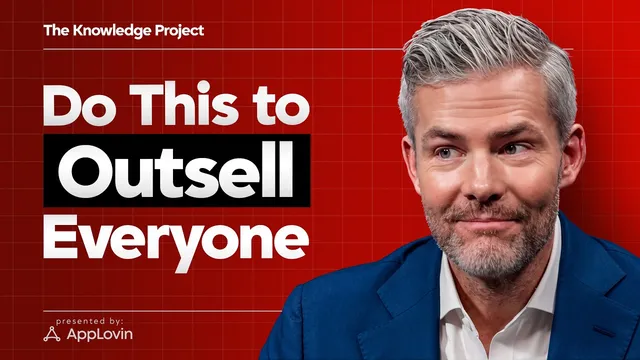
Full episode · 1 h 17 m
Bill Ackman: People are Going to Lose a Lot of Money
Bill Ackman says AI raises disruption risk, that venture valuations are frothy, and that he is turning Howard Hughes into a modern-day Berkshire Hathaway.
 The Knowledge Project · Shane Parrish with Bill Ackman
The best minutes
Also worth watching
- 48:07Why Ackman sold Netflix on a broken thesis, then bought it back4 min
Skip the 15-minute account of Lucy's hemorrhage and the brain institute, the sponsor reads and the Bremont watch story.
Summary · 4 min read instead of 1 h 17 m
Bill Ackman founded Pershing Square Capital Management, which runs several public vehicles and has an investment team that has stayed together for nine years. He chairs Howard Hughes, in which he holds 47%, and he owns a controlling stake in the watch company Bremont. He is also building a brain institute after his daughter Lucy's brain hemorrhage.
Ackman describes his daughter Lucy's brain hemorrhage and her recovery, and the brain rehabilitation institute he and his wife are building in response. He argues that AI has sharply raised the risk of business disruption, that parts of venture are in a bubble, and that founders should conserve cash. He explains Pershing Square's process for choosing durable growth companies, why he sold Netflix and bought it back, and why he gave up short selling and traditional activism. He says Howard Hughes is shifting from real estate to insurance on the Berkshire Hathaway model, using permanent capital and a long-term view.
Minute by minute
- 5:58
Building the world's greatest brain institute. Ackman says a Mount Sinai redevelopment would take about ten years, so he bought a vacant biotechnology building on a 3.4 acre site within 60 days. He wants the institute to use brain-computer interfaces, AI and better data from the brain to help patients like Lucy. He says his real estate, design and relationship skills fit the project, and that his wife will play an important role.
- 12:51
Why brain recovery care falls short. Ackman says insurers, economics and hospital incentives hold back recovery care. Neurosurgeons are paid for surgery rather than recovery, insurance may cover only six weeks of rehab, and many patients end up in nursing homes. The institute will focus on brain rehab, recovery and longevity, with AI speech therapy and better nutrition. Ackman hopes it becomes self-sustaining.
- 23:04
Venture shows bubble signs; founders should save cash. Ackman defines a bubble as fear of missing out pulling more money into the same trade until valuations are too high. He cites a company that raised $50 million at a $400 million valuation, then $50 million more at $1 billion two weeks later. He expects a high-profile blowup that resets the market. He advises founders to raise now, treat every dollar as their own and keep years of runway.
- 26:36
Venture bets on the founder, not the plan. Ackman says public-market investing depends on durable, dominant companies whose CEO can be replaced if needed. Venture depends far more on the founder, because the original idea often fails. His most successful venture investment began as a South Korean version of Groupon, a model he disliked. He backed the founder, who built the Amazon of South Korea.
- 28:33
AI sharply raises disruption risk. Ackman says an investor must judge what a business looks like 10 to 30 years out, and AI has greatly increased the risk of disruption. He notes Buffett missed the internet's disruption of businesses such as World Book, and says all investors will look foolish on some AI call. He expects AI to cut costs at big financial institutions, such as by rewriting legacy COBOL code, but says it is unclear whether they keep the savings.
- 33:37
A library of companies and a deep-dive process. Ackman says Pershing Square keeps a library of companies it has studied and waits for valuation opportunities, such as COVID or the software selloff, which let it buy Microsoft. Two team members do a deep dive using filings and expert networks, then present to the group. He says the team uses AI as a research tool rather than for models, because its best trades, such as credit default swaps before the pandemic, are not model outputs.
- 37:55
A stone-tablet checklist and an end to shorting. After a large loss around 2015 and 2016, Ackman says Pershing Square wrote its principles on a stone tablet. They cover simple, predictable, cash-generative large caps, strong management, asymmetric bets and an aversion to short selling. He explains that a short sale of a pyramid scheme went wrong when Carl Icahn bought the stock, and that the company attacked the firm and others tried to squeeze it.
- 48:07
Why Ackman sold Netflix and bought it back. Ackman says Pershing Square bought Netflix after a subscriber miss. Management told him it would never launch an advertising model, then reversed after missing again weeks later. He sold because the thesis broke and the range of outcomes widened, and put the money into Alphabet. After Netflix executed well and the stock later fell by half, the firm bought it back.
- 51:18
Howard Hughes becomes a modern Berkshire. Ackman says Howard Hughes was created from non-core assets spun out of General Growth, and now centers on master planned communities such as The Woodlands. Pershing owns 47%. It bought the insurer Vantage Holdings and hired a management team for it. He expects the business to shift from about 70% real estate to 70% or 75% insurance over five years, with Pershing managing the assets.
- 59:45
Permanent capital drives the Berkshire model. Ackman lists Berkshire's advantages as control, permanent capital, no dividends, strong stock picking, talented managers and no dilution. He recalls Munger saying Berkshire was almost never forced to decide by circumstances. Pershing Square's public vehicles have anchor stakes and permanent capital, which let it buy in crashes. He blames his biggest mistake on distraction from fundraising and says compounding could reach a trillion dollars in 20 years.
- 1:04:28
Bremont and how Ackman judges CEOs. Ackman says he bought eight Bremont watches in London, wrote to the owners and bought a minority stake. After a board fight he sided with CEO Davide Girotto and bought effective control. On hiring CEOs, he prefers people who have done the job before, checks them through expert networks, and says he can judge passion, capability and honesty in an hour.
Published Sep 29, 2026.