Full episode · 1 h 4 m
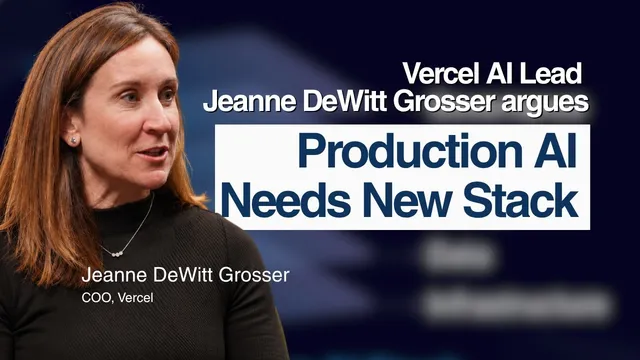
How Vercel Is Rethinking Go-to-Market With AI | COO Jeanne Grosser
Vercel COO Jeanne Grosser says AI agents let go-to-market teams run leaner, and that a founder's forecast needs checking against the math.
 Grit · Joubin Mirzadegan with Jeanne Grosser
The best minutes
- 13:30Never accept a founder's forecast without the pipeline math3 min
- 16:31Build an operating model to show what must be true4 min
- 57:49Vercel runs support, BDR and RevOps with agents3 min
Also worth watching
- 10:34How to tell a product gap from a go-to-market gap using 10 customer calls3 min
- 20:12Why she changed the sales plan four months in, and how3 min
- 47:49Lean versus fast hiring: Rubrik's counterargument and her coordination-cost view4 min
Skip the opening talk on why she works and burnout, and the long run on one-on-ones, Slack messages and AI-written decks.
Summary · 4 min read
Grosser spent a decade at Google, then a little over nine years at Stripe, where she joined at about 400 people and left as chief business officer at roughly 8,000. She has been COO of Vercel for almost a year and a half and owns marketing, sales, field engineering, support and partnerships.
Grosser describes how Vercel uses agents for support, outbound, inbound qualification and RevOps questions, and says she expects headcount-to-revenue ratios to matter more than team size. She argues that new go-to-market leaders should build an operating model early, because founders tend to set optimistic forecasts. She explains her three criteria for choosing a company and says the founder relationship is like a professional marriage that needs scheduled time. She also discusses telling founder noise from signal, her dislike of AI-written decks and summaries, and why she leans toward lean growth.
Minute by minute
- 1:41
Why keep working after Stripe. Grosser says she is a hardcore doer who ties her satisfaction to tangible progress each week, and she expects she would be bored and quickly irrelevant if she stopped. She advised Vercel while at Stripe, which supported advisorships. She took three days off between the two jobs.
- 6:29
The toll of hypergrowth. Grosser says people misunderstand how taxing fast growth is, though not growing is taxing too. At Vercel she had to transform a lot, and she wishes she had taken more time off after Stripe. On the day she announced the changes she got her best sleep in a year.
- 8:57
Product problem or go-to-market problem. Grosser says technical founders find it easier to blame sales than the product, which she links to short CRO tenures. At Vercel, the team ran 10 large enterprise customers through sessions with the product manager and lead engineer and concluded it lacked full enterprise product-market fit. Vercel also uses AI to extract objections from calls and file product requests automatically.
- 13:51
Grosser: founders forecast too optimistically. Grosser recounts advising an early-stage CRO who accepted a $10 million target without pipeline data or a released self-serve product. She told him he would be fired within a quarter unless he re-forecast from data. She says founders are default optimists who need big numbers to justify valuations.
- 16:40
Build an operating model first. At Stripe and Vercel, Grosser built an operating model showing what must be true to hit the founders' number. At Vercel it showed too little pipeline, which she took to the board weeks after joining. She hired a CMO within 90 days, and the company just barely beat its number.
- 20:13
Changing a sales team mid-year. Grosser says she and the CEO were open with each other before she joined, and the number stayed the same. Because quotas set livelihoods, she made changes four and a half months in rather than mid-Q3, and the executive team agreed to accept near-term downside. She says the change looked right about six weeks after a rough period.
- 23:31
Three criteria for choosing a company. Grosser traces her decade at Google to well-used values, a large market with natural adjacencies, and an engineer's engineer culture. She says Vercel meets all three. She believes every pixel on the internet could in time be built on Vercel.
- 29:02
Why she wants to be number two. Grosser says she wanted to be a strong right hand to a technical founder, not a CEO. She likes turning a technical vision into something customers buy. Owning marketing, sales and support together removes anyone else to blame for missing pipeline.
- 30:57
Managing the founder relationship. Grosser calls her relationship with the founder a professional marriage and agrees it matters more than anything else when joining a company. She insisted on a scheduled one-on-one and later added dinners, which she says made the time less transactional. She also credits a candid, non-political leadership team.
- 35:21
Separating signal from noise in founder messages. The host says founders panic about lost control and fire off details such as grammar errors. Grosser says she works out whether a message points to a pattern or a one-off, and sometimes debates whether it is a P0 or a P2. She says she tries to keep her own requests to her team predictable.
- 40:42
AI slop in decks and summaries. Grosser's latest pet peeve is AI-generated material that all looks the same, like decks and call summaries sent by sales. She says the team is paid to synthesize what matters, and customers will not want to read it either. The host adds that AI prep docs take an unnatural tone with him.
- 47:27
Efficiency as leverage has limits. Grosser says Stripe's early value of efficiency as leverage meant staying lean, and it was dropped once leanness became rate limiting. The host relays a Rubrik CEO's view that overly lean growth can leave revenue on the table. Grosser says overgrowing causes coordination costs and unclear jobs, and she leans toward the leaner side.
- 51:56
Headcount is a vanity metric. The host says adding headcount is seductive and works as a proxy for success, like valuations. Grosser agrees and asks new leaders to build the highest-performing team with the fewest people. Both expect leaders to be judged on headcount-to-revenue ratio rather than team size.
- 57:46
Which teams run leaner with AI. Grosser says BDR, support and RevOps are much leaner at Vercel. 91% of support volume is resolved by an agent, and agents handle inbound qualification and a lot of outbound. Vercel has raised sales quotas every six months, and the headcount-to-revenue ratio keeps rising.
Published Oct 5, 2026.