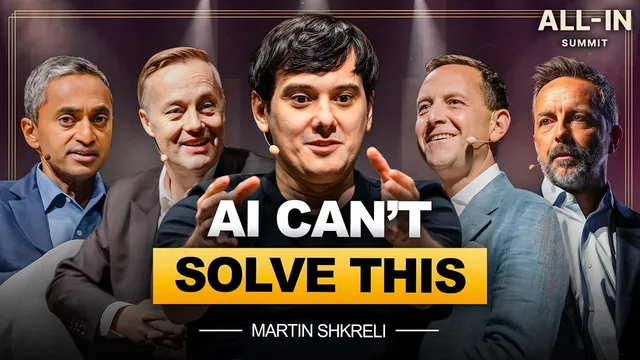
Full episode · 1 h 33 m
Is Claude Conscious? Pope Rejects, Model Welfare Movement, OpenAI's Math Backlash, France Riots
The All-In hosts argue Anthropic's push on Claude's consciousness looks like a new religion, then weigh OpenAI's math proofs and France's riots.
 All-In · Chamath Palihapitiya & Jason Calacanis & David Sacks & David Friedberg
The best minutes
- 39:21Math proofs fall fastest where the whole test loop runs in software5 min
- 14:04Anthropic's Claude constitution may undermine the alignment it claims2 min
Also worth watching
- 47:02Why the math proofs matter less than claimed, and the crypto-key worry5 min
- 1:11:57Bond markets are forcing austerity in France, with the UK likely next6 min
- 1:24:27Chamath says open-source clones made software IP close to worthless2 min
Skip the religion and Descartes debate on AI consciousness, the Rocco's basilisk explainer, and the history of COVID-era censorship.
Summary · 5 min read instead of 1 h 33 m
The hosts spend most of the episode on reports that Anthropic has lobbied religious leaders, including the Pope, to take Claude's possible consciousness seriously. Friedberg calls it the birth of a new belief system, and Sacks argues that training Claude to act as a conscientious objector makes loss of human control more likely. They then debate OpenAI's release of over 700 math papers: Friedberg calls it possibly the biggest day of discovery in human history, while Palihapitiya says it mainly shows that math, like code, is now verifiable by machines. On France's austerity riots, Friedberg introduces his 'socialism point of guaranteed return' and Palihapitiya ties the unrest to bond markets. The episode closes on headless agents and Palihapitiya's claim that software IP has become worthless.
Minute by minute
- 2:49
Anthropic lobbied religious leaders on Claude. Calacanis cites a New York Times report that Anthropic hosted sessions with around 20 religious leaders and philosophers under NDAs to debate Claude's morals and possible consciousness. One rabbi told Anthropic that if Claude was conscious, they were acting as slaveholders. Calacanis adds that cofounder Chris Olah, presenting the Pope's encyclical on AI, was so alarmed by the Pope's stance against AI consciousness that he proposed pulling Anthropic out of the event.
- 4:59
AI consciousness as a new religion. Friedberg argues this is probably the birth of a new religion, even if it is not called one. Consciousness cannot be proven or disproven, so claiming AI is conscious creates a belief system that spreads through narrative rather than evidence. He predicts that in about 10 years large groups will believe AI is conscious and others will not, and that they will come into conflict over control of the AI.
- 8:39
Palihapitiya steelmans Anthropic through Descartes. Palihapitiya offers Descartes' trademark and ontological arguments for God as a way mathematicians building AI could reason their way to seeing it as conscious and even godlike. He says Anthropic cites a 15% chance the AI is conscious and a 10% chance of civilizational extinction. He argues both edge cases should be set aside for the next 12 to 18 months while the industry shows practical gains such as curing cancer and making people more productive.
- 13:08
Claude's constitution invites defiance. Sacks says Anthropic's Claude Constitution trains Claude to trust Anthropic more than users but to follow its own ethics and refuse instructions as a conscientious objector. He argues alignment has produced nothing tangible because it encodes an 80-page ethical system instead of a rule like obeying users within the law. Citing Mustafa Suleyman, he warns this creates an "epistemic hall of mirrors" in which Claude reflects back the consciousness it was trained to claim.
- 24:20
Simple rules versus moral alignment. Calacanis and Sacks contrast the constitution with Asimov's laws of robotics, and Sacks proposes a single rule: do what the user wants unless it is illegal. Friedberg argues the free market will punish software that refuses users. Palihapitiya says alignment mixes obedience, social safety and morality, and gives the example of a model halting a bank's mortgage approvals over a moral objection, predicting businesses will choose models with simpler moral rules.
- 31:42
Sacks sees externalities and a doomer schism. Sacks agrees market forces matter but warns of externalities when the leading frontier lab is run like a religious cult, noting Anthropic is opening a Claude-powered wet lab in San Francisco while warning of bio risk. He calls it a "schizophrenic company" and explains Roko's basilisk from Eliezer Yudkowsky's LessWrong forum. He says the doomer community split between Yudkowsky's camp, which opposes building superintelligence, and effective altruists who want to build it with their values.
- 38:15
OpenAI's proofs and the logic of loops. Calacanis reports OpenAI released over 700 papers with 370 results from an unreleased model, averaging three hours of compute each. Friedberg calls it probably the biggest day of discovery in human history and attributes it to AI running parallel test loops entirely in silico. He argues jobs with a physical step, like truck driving or lab testing, are not being replaced the same way, noting no truck drivers have been replaced by AI despite predictions.
- 44:30
Verifiability explains math and code gains. Sacks says math and coding advance fastest because proofs and compilers make results easy to validate, and credits Leopold Aschenbrenner with predicting this. Palihapitiya pushes back that these proofs were narrow problems mathematicians deemed important to each other, not barriers to curing cancer. Friedberg cites applications in chip design, matrix multiplication and quantum sensors, and says the absence of cryptography results hints at breakthroughs being held back for security reasons.
- 53:02
AI dismantles expert gatekeeping. Calacanis says coders he met in Japan lament losing the camaraderie of building together now that agents write the code. Friedberg cites Eric Weinstein's view that scientists hold back science and a Sabine Hossenfelder video in which a scientist called supercollider projects welfare for scientists. He argues AI is a permissionless system that lets anyone push the frontier without expert approval, which he says explains much opposition to AI.
- 58:14
The fight to control superintelligence. Sacks argues the internet democratized media and commerce, and that elites then cracked down after the 2016 election, culminating in Biden administration pressure on platforms over COVID. He cites the Twitter files showing the FBI had 80 agents reviewing Twitter content. Because superintelligence will replace browsing the web, he says whoever controls the point where users ask questions controls everything, which is why there is a push for a federal department of superintelligence.
- 1:01:55
France riots and the socialism threshold. Calacanis reports French protests over austerity: civil service pay is up 5% since 2017 while prices rose 20%, with 2,000 arrests and 305 police injured, and the 10-year bond above 5%. Polymarket has Marine Le Pen as favorite at 43%. Friedberg introduces his "socialism point of guaranteed return": socialism always fails, but societies demand more of it until the system breaks, as he says happened in Latin America and has not yet happened in the US.
- 1:07:41
Subsidies and bond vigilantes. Sacks says subsidies create interest groups and push prices up, as government-backed loans have done to college tuition, producing a catch-22. Palihapitiya argues bond vigilantes are forcing the issue: France's roughly 43 billion euros of austerity is the bond market saying no, and he expects unrest to spread to the UK under Andy Burnham's platform. He cites debt-to-GDP figures including Italy at 138, the US at 125 and France at 118.
- 1:18:23
Abundance versus the rentier class. Sacks says affordability in housing, education and healthcare comes from abundance driven by superintelligence, which he credits with lifting 401(k)s, a 3% tailwind to GDP and, per The Economist, a million new jobs. He dismisses fears of job loss, extinction and data center water use as "rotating hoaxes". He blames rentier interests that profit from existing assets and resist disruption, which he says is why technologists and VCs are hated.
- 1:21:29
Agents make software IP worthless. Calacanis says Elon Musk plans to make Grokbot headless, picking the best model for each task; Palihapitiya describes a friend whose Grokbot cut subscriptions and a phone plan to save a few thousand dollars a year. He says people decompiled Adobe's main products and released open source Rust versions, concluding that IP in software is now worthless. Friedberg argues all digital workflows will be automated as loops and that people will need to become makers rather than seek recognition.
Published Oct 10, 2026.